
An oscillator crystal is an electronic component that helps a circuit generate a stable frequency. Quartz crystals are widely used in electronics to control the timing of microcontrollers, digital circuits, clocks, watches, and communication equipment. They are available in several packages, including metal can types, low-profile packages, and tiny watch crystals. In this beginner-friendly guide, you will learn how an oscillator crystal works, how to recognize common crystal packages, how to identify the crystal schematic symbol, and how to choose the right crystal for an electronic circuit.
What Is an Oscillator Crystal?
An oscillator crystal is a component that uses the mechanical resonance of a piece of quartz to help an electronic circuit produce a precise, stable frequency. It is also known as a quartz crystal resonator.
Quartz has a special property called the piezoelectric effect. When a voltage is applied to a suitable quartz crystal, it can deform slightly. Conversely, mechanical deformation of the crystal produces an electrical response. This interaction allows a quartz crystal to resonate at a particular frequency.
A quartz crystal does not normally generate a continuous electrical signal by itself. Instead, it works with an electronic circuit containing an amplifier and other components to form a quartz oscillator.
The crystal helps determine the frequency at which the circuit oscillates. Because quartz has a high quality factor, or Q factor, its resonant frequency is relatively stable compared with many simple electronic timing circuits.
An oscillator crystal is useful when a circuit needs accurate timing or a reliable frequency reference. Common applications include:
- Microcontroller clock circuits.
- Digital clocks and watches.
- Real-time clock (RTC) modules.
- Computers and communication equipment.
- Frequency reference circuits.
- Radio transmitters and receivers.
- Electronic measuring instruments.
Oscillator Crystal Schematic Symbol
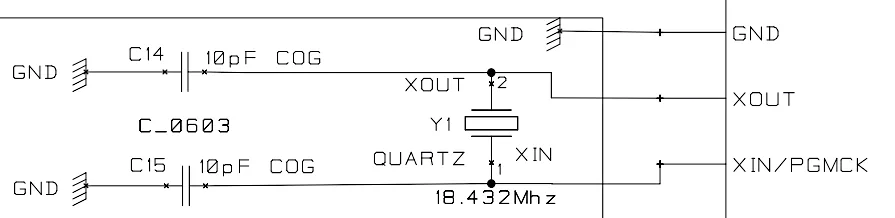
The schematic symbol for a quartz crystal represents a small resonating element positioned between two plates, as the image below shows. The plates represent the electrodes connected to the crystal.

In a circuit diagram, the crystal symbol is usually labeled with a reference designator such as Y1, Y2, or X1. The exact designation depends on the circuit designer’s conventions. The component’s frequency is often written next to the symbol.
For example, a schematic might show a crystal labeled Y1 with a value of 16 MHz. This means the circuit uses a crystal designed to operate at a nominal frequency of 16 megahertz.
The crystal normally has two electrical connections. In a typical microcontroller circuit, these connect to the microcontroller’s crystal oscillator pins, often with two capacitors connected to ground. The exact circuit depends on the microcontroller and the crystal’s specifications. An example is shown in the following image where the reference designator of the crystal is Y1, and the frequency of the crystal is 18.432MHz. Only part of the microcontroller symbol can be seen at the right of the image where the crystal connects to the XOUT an XIN pins of the microcontroller.
A crystal symbol should not be confused with the symbols for a ceramic resonator or an inductor. Although these components can all be used in frequency-related circuits, their electrical and physical properties differ.
Types of Oscillator Crystal Used in Electronics
Quartz crystals are available in several physical packages. The package depends on the crystal’s frequency, intended application, size requirements, and manufacturing design.
The most common types you will encounter when learning electronics are metal can crystals, low-profile crystals, and watch crystals.
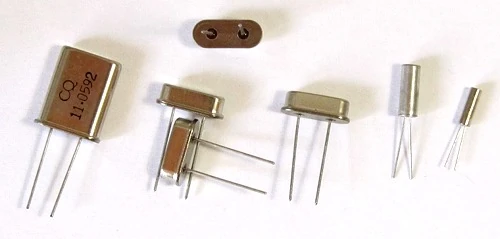
Examples of different crystals used in electronics are shown in the image below. At the left is a tall metal can crystal, with the lower profile type to the right of it. At the right of the image are two different sized watch crystals.
Metal Can Oscillator Crystals
Metal can crystals are common in hobby electronics and through-hole circuit construction. They have a metal enclosure that protects the quartz element and typically have two wire leads for mounting through holes in a printed circuit board.
These crystals are often marked with their nominal frequency, such as 4 MHz, 8 MHz, 11.0592 MHz, 16 MHz, or 20 MHz. The available frequencies depend on the manufacturer and package.
Metal can crystals are frequently used with microcontrollers, digital logic circuits, and development boards. Their leads make them convenient for prototyping and soldering.
Some common metal can package styles include:
- HC-49/U: A relatively tall, traditional metal can package.
- HC-49/S: A shorter, low-profile version of the traditional package.
- Other through-hole metal packages: Designs that vary in dimensions and lead spacing.
The package name alone does not tell you the crystal’s frequency. Always check the component marking or its datasheet.
Low-Profile Quartz Crystals
Low-profile crystals are similar to traditional metal can crystals but have a shorter enclosure. They are useful where circuit board height is limited.
These components may be found in embedded electronics, microcontroller boards, and other digital circuits. They can provide the same basic function as taller metal can crystals when their electrical specifications are suitable for the circuit.
When replacing a crystal, check the frequency, package dimensions, load capacitance, and other electrical specifications. A crystal that looks similar to the original is not necessarily a suitable replacement.
Watch Crystals and 32.768 kHz Crystals
Watch crystals are small quartz crystals designed for low-frequency timing applications. A particularly common frequency is 32.768 kHz, which is widely used in watches, clocks, and real-time clock circuits.
The reason for this specific frequency is straightforward: 32,768 is . A digital circuit can divide the frequency by two 15 times to obtain a one-pulse-per-second signal. This makes a 32.768 kHz crystal particularly useful for keeping track of seconds, minutes, and hours with a low-power electronic circuit.
Watch crystals are often much smaller than the metal can crystals used for general-purpose microcontroller clocks. Some have tiny cylindrical metal enclosures, while others use miniature surface-mount packages.
Because of their low operating frequency and small size, these crystals are especially useful in battery-powered devices.
Surface-Mount Oscillator Crystals
Surface-mount device (SMD) crystals are designed to be soldered directly onto the surface of a printed circuit board. They are common in modern electronics, where compact circuit boards and automated assembly are important.
SMD crystals are available in many package sizes. Some are small rectangular metal packages, while others have ceramic packages or different enclosure designs. They are used in microcontrollers, wireless devices, computers, consumer electronics, and other products that require a compact frequency reference.
Unlike many traditional through-hole crystals, SMD crystals do not have long wire leads. Their terminals are designed to make contact with matching pads on the circuit board.
When selecting an SMD crystal, pay attention to the package dimensions and the arrangement of its terminals. A physically different package may not fit the existing circuit board.
Quartz Crystal Packages Compared
The following table summarizes common crystal package types and their typical applications. The package helps you recognize a crystal, but it does not determine its operating frequency. Check the markings and datasheet before using a component.
| Crystal Type | Physical Appearance | Common Applications |
|---|---|---|
| Traditional metal can | Tall metal enclosure with two leads | Microcontrollers, digital circuits, hobby projects |
| Low-profile metal can | Short metal enclosure with two leads | Embedded electronics and compact through-hole boards |
| Watch crystal | Very small cylindrical or miniature package | Watches, clocks, real-time clock circuits |
| Surface-mount crystal | Compact rectangular or other SMD package | Modern microcontrollers, wireless devices, compact electronics |
How Does a Quartz Crystal Oscillator Work?
A quartz crystal oscillator combines a quartz crystal with an electronic circuit that sustains electrical oscillation. The crystal has one or more resonant frequencies determined by its physical characteristics. When connected to a suitable oscillator circuit, it provides frequency-selective feedback that helps the circuit oscillate at the desired frequency.
A basic oscillator circuit generally includes:
- A quartz crystal that establishes the preferred resonant frequency.
- An amplifier or active device that compensates for energy lost during oscillation.
- Feedback connections that sustain oscillation.
- Additional components, such as capacitors, when required by the oscillator design.
When power is applied, small electrical disturbances occur in the circuit. The amplifier and feedback network build up oscillation around the crystal’s resonant frequency. The resulting signal can be used as a clock or frequency reference.
The crystal itself is a passive component. A complete quartz crystal oscillator circuit requires an active circuit to sustain oscillation. Microcontrollers often have built in oscillators that only require an external crystal to be connected to it via two of the microcontrollers’ pins. Two capacitors are usually needed in addition to the crystal in this type of circuit.
The term “crystal oscillator” can refer to a complete oscillator circuit or to a packaged module that contains both the crystal resonator and its oscillator electronics.
Quartz Crystal Resonator Versus Quartz Oscillator
The terms quartz crystal resonator and quartz oscillator are related, but they do not mean exactly the same thing.
A quartz crystal resonator is the passive component that provides a stable resonant frequency. It usually has two terminals and requires an external circuit to sustain oscillation.
A quartz oscillator is an active circuit or module that produces an oscillating output signal. It may use a separate crystal connected to an amplifier, or it may contain the crystal and supporting circuitry inside one package.
Understanding this difference helps you select the right component. A two-terminal crystal cannot generally be substituted directly for a powered oscillator module because their electrical connections and output requirements differ.
| Feature | Quartz Crystal Resonator | Quartz Oscillator |
|---|---|---|
| Main function | Provides a stable resonant frequency | Generates an oscillating electrical output |
| Active electronics | Not normally included | Included in the oscillator circuit or module |
| Power supply | Not normally required by the crystal itself | Required by an active oscillator |
| Typical use | Connected to a microcontroller’s oscillator circuit | Used as a clock or frequency reference source |
Common Frequencies of Oscillator Crystals
An oscillator crystal is manufactured for a particular nominal frequency. The frequency you need depends on the application and the requirements of the circuit. Some common examples are listed below.
These are examples rather than universal recommendations. Not every microcontroller or circuit supports every frequency, and some applications require a specific frequency for correct operation.
| Nominal Frequency | Typical Applications |
|---|---|
| 32.768 kHz | Watches, clocks, and real-time clock circuits |
| 1 MHz | Timing circuits and some microcontroller applications |
| 4 MHz | Microcontrollers and digital electronics |
| 8 MHz | Microcontrollers, embedded systems, and development projects |
| 11.0592 MHz | Serial communication applications and some microcontroller circuits |
| 12 MHz | Digital circuits, microcontrollers, and USB-related designs where supported |
| 16 MHz | Many microcontroller development boards and digital circuits |
| 20 MHz | Microcontrollers and other digital circuits that support this frequency |
Why Is 11.0592 MHz a Common Crystal Frequency?
The 11.0592 MHz crystal is frequently encountered in microcontroller projects, particularly those involving traditional asynchronous serial communication.
This frequency divides conveniently into common serial baud-rate timing values when used with suitable timer and clock configurations. It can therefore make it easier to generate standard serial communication rates with some microcontrollers.
A different crystal frequency may be more suitable for other applications. For example, modern microcontrollers may have flexible clock generators, internal oscillators, or dedicated peripheral clock circuits that change which frequencies are most useful.
Always consult the microcontroller documentation before selecting a crystal frequency.
Using an Oscillator Crystal With a Microcontroller
Many microcontrollers can operate using an internal oscillator, an external crystal, or an external clock source. The options available depend on the specific device. An external crystal can provide a stable clock reference when the internal oscillator does not meet the application’s accuracy requirements.
A typical crystal circuit may use the following components:
- A quartz crystal connected between the microcontroller’s oscillator pins.
- Two load capacitors connected between the crystal connections and ground, where required by the design.
- Short circuit board traces to reduce unwanted capacitance and interference.
The capacitors are not arbitrary. Their values depend on the crystal’s specified load capacitance and the total capacitance contributed by the microcontroller pins and circuit board.
A simplified example is a microcontroller using a 16 MHz crystal. The microcontroller’s oscillator circuit drives the crystal and produces the clock signal needed to execute instructions and time certain operations.
The exact connection method differs between microcontrollers. Some devices include an internal oscillator amplifier that is designed to work with an external crystal. Others may need a different circuit arrangement or an external oscillator module.
Important: Check the microcontroller datasheet and its recommended crystal circuit before building the circuit. Using an unsuitable crystal or incorrect load capacitors can prevent reliable startup or cause the oscillator to operate outside its intended specifications.
What Is the Difference Between a Crystal and a Ceramic Resonator?
Quartz crystals and ceramic resonators are both used to establish resonant frequencies in electronic circuits. However, they differ in their materials, performance, and typical applications.
A quartz crystal uses a specially manufactured quartz element. A ceramic resonator uses a piezoelectric ceramic material.
Quartz crystals generally provide better frequency accuracy and stability than inexpensive ceramic resonators. Ceramic resonators can be smaller, less expensive, and convenient for applications where extremely accurate timing is not essential.
Neither component is automatically the best choice for every application. The correct choice depends on frequency accuracy, stability, cost, startup behavior, and the circuit’s requirements. The following table compares the two devices.
| Feature | Quartz Crystal | Ceramic Resonator |
|---|---|---|
| Resonating material | Quartz | Piezoelectric ceramic |
| Frequency accuracy | Generally higher | Generally lower |
| Frequency stability | Generally better | Generally lower |
| Typical applications | Accurate timing, clocks, communication circuits | Cost-sensitive timing and general microcontroller applications |
| Circuit requirements | Depends on crystal and oscillator design | Depends on resonator type and circuit design |
Tips for Oscillator Crystal Selection and Use
Choosing the right oscillator crystal involves more than matching its frequency. The following tips will help you avoid common mistakes when building or repairing electronic circuits.
1. Check the Required Frequency
Select the frequency specified by the circuit diagram or microcontroller documentation. A crystal with the wrong frequency can cause timing errors or prevent a circuit from operating correctly.
2. Check the Load Capacitance
Quartz crystals are commonly specified for a particular load capacitance, expressed in picofarads (pF). The oscillator circuit must provide a suitable load for the crystal.
If external capacitors are required, their values should be calculated or selected according to the crystal and microcontroller datasheets. The effective load capacitance also includes parasitic capacitance from circuit board traces and the oscillator input pins.
3. Identify the Package
Make sure the crystal’s physical dimensions and mounting style suit the circuit board. A through-hole crystal cannot automatically replace a surface-mount component, even if the electrical specifications are identical.
4. Keep Oscillator Connections Short
Long traces can add unwanted capacitance and pick up electrical noise. Follow the manufacturer’s layout recommendations, keep crystal connections short, and place any required load capacitors close to the relevant pins.
5. Do Not Confuse a Crystal With an Oscillator Module
A crystal resonator is normally a passive component. An oscillator module contains active electronics and typically requires a power supply and ground connection in addition to its output. Check the component’s datasheet before connecting it to a circuit.
6. Check Frequency Tolerance and Stability
The nominal frequency does not tell you exactly how close the crystal will be to that frequency in every situation.
Frequency tolerance describes the allowed deviation under specified conditions. Frequency stability describes how the frequency changes with factors such as temperature, aging, and operating conditions.
Applications that require precise timing may need tighter specifications than ordinary hobby circuits.
7. Handle Small Crystals Carefully
Small crystals can be damaged by excessive mechanical stress, incorrect soldering practices, or unsuitable circuit conditions. Follow the manufacturer’s handling and soldering recommendations, especially for miniature surface-mount parts.
Crystal Manufacturers and Their Products
Several established electronics manufacturers produce quartz crystals and crystal oscillators for applications ranging from simple microcontroller circuits to precision timing systems. Their websites are useful sources of component specifications, datasheets, package dimensions, and application information.
When looking for an oscillator crystal for a hobby electronics project, start with the manufacturer’s product catalog. You can use these catalogs to identify the required frequency, package type, load capacitance, and other electrical characteristics.
Major Quartz Crystal and Crystal Oscillator Manufacturers
The following manufacturers have official websites with information about their crystal products and, where indicated, complete crystal oscillators.
| Manufacturer | Quartz Crystals | Crystal Oscillators | Website and Product Links |
|---|---|---|---|
| Epson | Yes | Yes | Crystal units and crystal oscillators |
| Vishay | Yes | Yes | Quartz crystals and oscillators |
| NDK (Nihon Dempa Kogyo) | Yes | Yes | Crystal units and crystal oscillators |
| TXC Corporation | Yes | Yes | MHz crystals and 32.768 kHz crystals |
| Abracon | Yes | Yes | Quartz crystals and timing products |
These manufacturers offer products for different applications and performance requirements. Epson, NDK, and TXC have extensive crystal and oscillator product ranges, while Vishay and Abracon also provide dedicated product catalogs for frequency-control components.
Choosing a Crystal From a Manufacturer’s Catalog
When browsing these websites, it is important to distinguish a quartz crystal resonator from a complete crystal oscillator. A crystal resonator is normally a passive component that needs a suitable oscillator circuit, whereas a crystal oscillator includes active circuitry that produces an output signal.
Before ordering a component, check the following specifications:
- Nominal frequency: For example, 32.768 kHz, 8 MHz, or 16 MHz.
- Package type: Through-hole metal can, miniature cylindrical package, or surface-mount package.
- Load capacitance: Important when selecting a crystal for a microcontroller oscillator circuit.
- Frequency tolerance: Indicates how closely the actual frequency matches the nominal frequency under specified conditions.
- Operating temperature range: Particularly important for equipment exposed to changing temperatures.
- Electrical requirements: For a complete oscillator, check its supply voltage, output type, and output frequency.
For beginners, the manufacturer’s datasheet is usually the best source of technical information. It helps confirm whether a particular oscillator crystal will work with the intended circuit and prevents mistakes when choosing between a passive crystal and a complete oscillator module.
Did You Know?
Quartz crystals have several interesting properties and uses that make them important components in modern electronics.
A 32.768 kHz Crystal Is Based on a Power of Two
The frequency of 32.768 kHz is equal to 32,768 cycles per second, or Hz.
Digital circuits can divide this frequency by two repeatedly. After 15 divisions, the result is one cycle per second, making it convenient for timekeeping circuits.
Quartz Is Used Because of Its Piezoelectric Properties
Quartz can convert mechanical energy into electrical energy and electrical energy into mechanical deformation. This piezoelectric behavior makes it suitable for resonators and other frequency-sensitive components.
A Crystal Does Not Usually Produce an Output Signal on Its Own
Although a quartz crystal resonates, it does not normally supply a sustained electrical clock signal without a suitable active circuit. The amplifier and feedback network provide the energy needed to maintain oscillation.
Crystals Are Used Far Beyond Watches and Microcontrollers
Quartz-based frequency references are used in communication equipment, computers, measuring instruments, industrial electronics, and many other systems. The required frequency accuracy and stability depend on the application.
Frequently Asked Questions
What Is an Oscillator Crystal Used For?
An oscillator crystal provides a stable resonant frequency for an electronic circuit. It is commonly used with microcontrollers, digital clocks, watches, communication equipment, and other devices that need accurate timing or a frequency reference.
Is an Oscillator Crystal the Same as a Quartz Crystal?
In common electronics terminology, the terms often refer to the same type of component. More precisely, a quartz crystal is a passive resonator, while an oscillator is the active circuit that uses the resonator to produce a sustained oscillating signal.
What Does the Crystal Symbol Mean on a Circuit Diagram?
The crystal schematic symbol represents a resonating element between two electrodes. It is normally labeled with a reference designator such as Y1 or X1, together with its nominal frequency.
Why Do Watches Use 32.768 kHz Crystals?
A 32.768 kHz crystal has a frequency of Hz. A digital divider can divide this frequency by two 15 times to produce a one-pulse-per-second signal, which is useful for timekeeping.
Can I Replace an Oscillator Crystal With One of a Different Frequency?
Only if the circuit is designed to support the replacement frequency. Changing the crystal frequency can affect the microcontroller’s clock rate, serial communication timing, peripheral operation, and other functions. Check the circuit documentation before making a substitution.
Does a Quartz Crystal Need a Power Supply?
A standard quartz crystal resonator is a passive component and does not need its own power supply. However, it normally needs an active oscillator circuit to sustain oscillation. A complete oscillator module requires power to operate.
What Is the Difference Between a Quartz Crystal and a Quartz Crystal Oscillator?
A quartz crystal resonator provides a stable resonant frequency but does not normally generate a sustained output signal by itself. A quartz crystal oscillator includes the active electronics needed to produce an oscillating signal using a crystal or another frequency-setting element.
How Can I Identify the Frequency of a Quartz Crystal?
Look for a frequency marking printed on the crystal’s enclosure. Some components display a value such as 16.000, while others may have a less obvious code. If the marking is unclear, consult the manufacturer’s datasheet or identify the component using its part number.
Can I Test a Quartz Crystal With a Multimeter?
A standard multimeter generally cannot confirm whether a crystal oscillates at its specified frequency. It may help identify obvious electrical faults, but testing frequency and startup behavior usually requires a suitable oscillator test circuit, frequency counter, or oscilloscope with appropriate measurement techniques.
Conclusion
An oscillator crystal is an important component in electronics because it helps circuits generate stable frequencies for accurate timing and reliable operation. Quartz crystals are available in traditional metal can packages, low-profile packages, miniature watch crystals, and surface-mount formats, making them suitable for a wide range of applications.
Understanding the crystal schematic symbol, common frequencies, and differences between a passive resonator and a complete quartz oscillator will help you recognize these components in circuit diagrams and electronic projects. When selecting a crystal, always check its frequency, load capacitance, package, and compatibility with the circuit. These basic principles provide a solid starting point for using quartz crystals in microcontroller projects and other electronic designs.
Learn about more components and tools used in electronics.