
Connecting batteries in parallel is a useful way to increase the total capacity of a battery supply without increasing its output voltage. This type of battery connection is commonly used in solar power systems, backup power supplies, portable electronics, and other applications where a longer operating time is needed.
When batteries are connected in parallel, all their positive terminals are connected together, and all their negative terminals are connected together. The voltage remains the same as that of a single battery, but the available capacity (measured in ampere-hours) increases.
Understanding how batteries in parallel work is important when designing battery-powered circuits and choosing the correct battery configuration. In this guide, we look at how parallel battery connections work, how to wire batteries correctly, and how parallel connections compare with series connections.
How Do Batteries in Parallel Work?
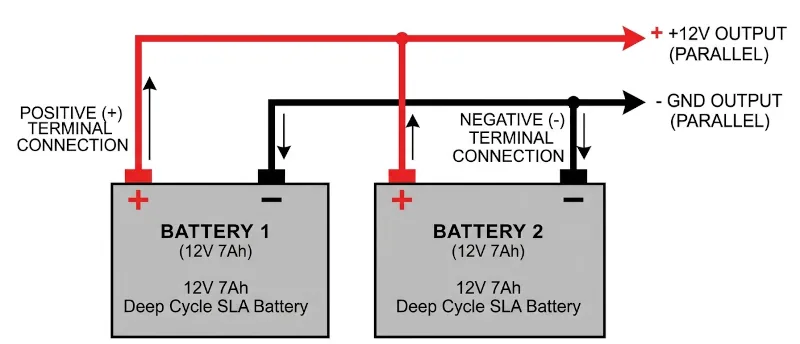
Batteries connected in parallel have their positive terminals connected together and their negative terminals connected together. This arrangement keeps the output voltage the same as that of one battery while increasing the total available capacity. The following image shows two identical 12V batteries wired in parallel. In this arrangement, more current is available to a load connected to the lugs at the bottom right of the image, than if only one battery were used.

Connecting two identical 12V, 7Ah batteries in parallel produces a battery bank with the following specifications:
- Voltage: 12V
- Capacity: 14Ah
- Nominal energy: 168Wh
Below is a diagram of two 12V batteries connected in parallel. This diagram illustrates the connections of the batteries in the above photograph. The device or electrical load to be powered by the two batteries must be connected to the positive and negative lugs shown at the right of the photo and diagram.
Each battery supplies part of the total current required by the load. Because the batteries share the load, the combined battery bank can generally supply power for longer than either battery could individually.
The important thing to remember is that parallel connection increases capacity, not voltage. This makes parallel battery connections useful when a circuit requires a particular voltage but needs more operating time.
Parallel Battery Connection Explained
A parallel battery connection is made by connecting corresponding battery terminals together. For two batteries of the same voltage and capacity, the connections are:
- Connect the positive terminal of the first battery to the positive terminal of the second battery.
- Connect the negative terminal of the first battery to the negative terminal of the second battery.
- Connect the load across the combined positive and negative terminals.
The load now receives the same nominal voltage as one battery, but the combined battery capacity is greater.
Batteries in Parallel Circuit Diagram
The following diagram shows two batteries connected in parallel, with a load connected across the battery bank at the right. A resistive load is shown, but this could be any resistive, inductive, electrical or electronic load, such as a lamp, motor, circuit board, and so forth.
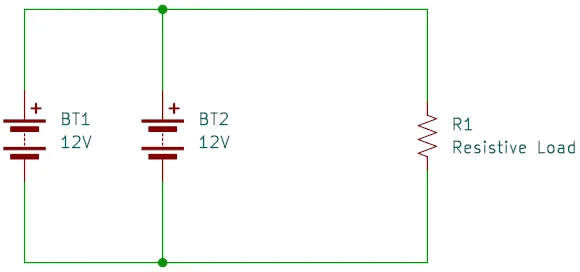
Notice that both positive battery terminals connect to the same positive supply line. Both negative terminals connect to the same negative supply line. This means that the batteries are effectively connected across the same two electrical points.
What Happens When You Connect More Batteries in Parallel?
The same principle applies when connecting three or more batteries. For example, four identical 12V, 7Ah batteries connected in parallel produce:
- Voltage: 12V
- Capacity: 28Ah (7Ah x 4)
- Nominal energy: 336Wh (12V x 28Ah)
The voltage does not increase as more batteries are added. Instead, each additional battery contributes more capacity to the battery bank.
The general formula for calculating the total capacity is:
Where:
- = Total battery capacity in ampere-hours (Ah)
- = Individual battery capacities
- = Number of batteries
For identical batteries, this simplifies to:
Where is the capacity of one battery.
Batteries in Parallel: Voltage and Capacity Calculations
Let’s look at some practical examples to understand how connecting batteries in parallel affects the voltage and capacity of a battery supply.
Assume that all the batteries have the same nominal voltage and capacity.
| Number of Batteries | Battery Voltage | Capacity per Battery | Total Capacity |
|---|---|---|---|
| 1 | 12 V | 7 Ah | 7 Ah |
| 2 | 12 V | 7 Ah | 14 Ah |
| 3 | 12 V | 7 Ah | 21 Ah |
| 4 | 12 V | 7 Ah | 28 Ah |
| 5 | 12 V | 7 Ah | 35 Ah |
As you can see, the voltage remains at 12V, regardless of how many batteries are connected in parallel. The capacity increases in direct proportion to the number of identical batteries connected.
Calculating the Operating Time of Batteries in Parallel
Increasing battery capacity also increases the potential operating time of a battery-powered circuit.
The approximate operating time can be calculated using:
Where:
- = Operating time in hours
- = Battery capacity in ampere-hours
- = Load current in amperes
For example, suppose a circuit draws 1A from a battery bank consisting of two 12V, 7Ah batteries connected in parallel.
The total capacity is:
The theoretical operating time is:
The battery bank could therefore theoretically supply the 1A load for 14 hours, whereas a single 7Ah battery could theoretically supply 1A for 7 hours.
In practice, the actual operating time will usually be shorter because of factors such as:
- Battery discharge characteristics.
- Internal resistance.
- Temperature.
- Battery age and condition.
- Maximum recommended depth of discharge.
- Power losses in wiring and connections.
The usable capacity also depends on battery chemistry. For example, lead-acid batteries generally should not be regularly discharged as deeply as many lithium battery types.
Parallel Battery Wiring: How to Connect Batteries Correctly
Correct parallel battery wiring is important for both performance and safety. Although the electrical connections appear simple, there are some important considerations when connecting multiple batteries.
Wiring Two Batteries in Parallel
For two batteries, follow these steps:
- Make sure both batteries have the same nominal voltage.
- Check that they are compatible batteries with similar chemistry and charging requirements.
- Ensure that both batteries are at similar states of charge.
- Connect the positive terminals together using appropriately rated cables.
- Connect the negative terminals together using appropriately rated cables.
- Connect the load to the combined battery supply.
Use cables that can safely carry the expected current. A properly rated fuse or suitable circuit breaker should be installed close to the positive terminal of each battery. This helps protect the wiring if a short circuit occurs.
Wiring Three or More Batteries in Parallel
When connecting several batteries, the wiring arrangement becomes more important. A common method is to use positive and negative busbars.
A busbar provides a common connection point for all the positive terminals and another common connection point for all the negative terminals. Each battery connects to the corresponding busbar.
This arrangement has several advantages:
- It provides a neat and organized wiring layout.
- It makes it easier to add or remove batteries.
- It can help achieve more balanced current sharing.
- It provides convenient connection points for the load and charging equipment.
Why Balanced Wiring Matters
When several batteries are connected in parallel, the current should ideally be shared between them. However, differences in cable resistance and connection resistance can cause some batteries to supply more current than others.
For example, consider two batteries connected to a load using cables of different lengths. The battery with the shorter, lower-resistance cable may supply more current. This can result in uneven charging and discharging.
One way to improve current sharing is to use equal-length cables of the same cross-sectional area.
For larger battery banks, busbars or properly designed diagonal connections can help improve current distribution.
What Happens to Current When Batteries Are Connected in Parallel?
When batteries are connected in parallel, the total current supplied to a load is shared between the batteries. For example, suppose two identical batteries are connected in parallel to a circuit that draws 4A.
Ideally, each battery supplies half the current:
The total current is:
This is an example of Kirchhoff’s Current Law, which states that the total current entering a junction equals the total current leaving it. However, current sharing is not always exactly equal. It depends on factors such as:
- Internal battery resistance.
- Cable resistance.
- Connection quality.
- Battery state of charge.
- Battery condition and temperature.
A battery with lower internal resistance may supply a larger proportion of the load current. This is one reason why using closely matched batteries is important.
Connecting Parallel Batteries: Important Safety Precautions
Connecting batteries in parallel can be straightforward, but it must be done carefully. A particularly important issue is the possibility of high circulating current between batteries.
Match Battery Voltage Before Connecting
Never assume that two batteries can safely be connected in parallel simply because they have the same nominal voltage. For example, two 12V batteries may have different actual terminal voltages, depending on their state of charge. A fully charged battery will typically have a voltage that is higher than its rated or nominal voltage.
If one battery is at a significantly higher voltage than the other, current can flow from the higher-voltage battery into the lower-voltage battery as soon as they are connected. This current can be very high, particularly when the batteries have low internal resistance.
Before making a parallel connection:
- Check the actual terminal voltage of each battery.
- Make sure their states of charge are compatible.
- Follow the battery manufacturer’s instructions for parallel connection.
- Use suitable current-limiting or protective equipment where required.
For lithium batteries, the manufacturer’s specified voltage matching and connection procedure is particularly important.
Use Batteries of the Same Type
Ideally, use batteries that have:
- The same nominal voltage.
- The same chemistry.
- The same capacity.
- The same model and specifications.
- Similar age and condition.
Avoid mixing different battery chemistries, such as lead-acid and lithium batteries, in the same directly connected parallel bank. Different battery types have different charging requirements and discharge characteristics.
Install Individual Battery Fuses
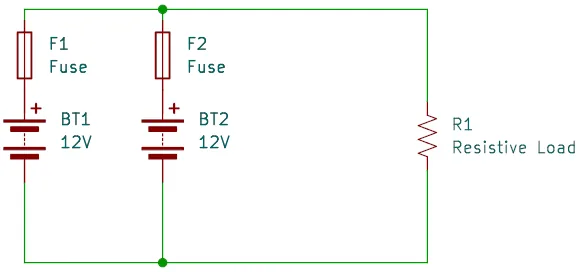
Each battery in a parallel bank should have appropriate overcurrent protection. This is important because a fault in one battery or its wiring could allow the other batteries to feed a very large current into the fault.
Individual battery fuses should be installed close to the positive battery terminals and selected according to the cable ratings, expected current, and system requirements. The following circuit diagram shows two batteries connected in parallel, each with its own protection fuse.
Use the Correct Cable Size
The cables connecting batteries must be capable of carrying the expected current without excessive voltage drop or overheating. A wire size chart helps identify the appropriate wire diameter, current capacity, and material for your application.
The required cable size depends on:
- Maximum current.
- Cable length.
- Permitted voltage drop.
- Cable installation conditions.
- Applicable electrical safety standards.
Do not assume that cables suitable for connecting one battery will automatically be suitable for a larger battery bank.
Check the Battery Manufacturer’s Instructions
Some batteries, especially lithium batteries with built-in battery management systems (BMS), have restrictions on parallel connections.
These may include:
- Maximum number of batteries that can be connected.
- Required battery matching procedures.
- Restrictions on connecting batteries of different ages.
- Communication requirements between battery management systems.
- Specific charging and discharging limits.
Always follow the manufacturer’s instructions.
Parallel V Series Batteries: What Is the Difference?
The main difference between parallel and series battery connections is how they affect voltage and capacity.
- With batteries in parallel, the voltage remains the same while the capacity increases.
- With batteries in series, the voltage increases while the ampere-hour capacity remains the same.
Batteries Connected in Parallel
When two identical 12V, 7Ah batteries are connected in parallel:
- Total voltage = 12V
- Total capacity = 14Ah
- Total nominal energy = 168Wh
The positive terminals are connected together, and the negative terminals are connected together.
Batteries Connected in Series
When the same two batteries are connected in series:
- Total voltage = 24V
- Total capacity = 7Ah
- Total nominal energy = 168Wh
The positive terminal of the first battery is connected to the negative terminal of the second battery. The remaining positive and negative terminals become the output connections.
Parallel vs Series Battery Comparison
| Feature | Parallel Connection | Series Connection |
|---|---|---|
| Voltage | Remains the same | Adds together |
| Capacity (Ah) | Adds together | Remains the same |
| Positive terminals | Connected together | Not connected together |
| Negative terminals | Connected together | Not connected together |
| Operating time | Generally increases | Depends on load and energy |
| Common application | Increasing battery capacity | Increasing supply voltage |
An important point is that both arrangements increase the total stored energy when additional identical batteries are added. For example, two 12V, 7Ah batteries contain a combined nominal energy of 168Wh, whether connected in series or parallel. The difference is how that energy is delivered in terms of voltage and current.
Can Batteries Be Connected in Series and Parallel?
Yes. Batteries can be arranged in combinations of series and parallel connections. This is sometimes called a series-parallel battery configuration. For example, four identical 12V, 7Ah batteries can be arranged as two parallel pairs connected in series.
Each parallel pair produces:
- 12V
- 14Ah
Connecting the two pairs in series produces:
- 24V
- 14Ah
This arrangement is useful when a system needs both a higher voltage and greater capacity. However, series-parallel configurations require careful planning to ensure that the batteries are properly matched and that the charging system is compatible with the complete battery bank.
What Are the Advantages of Batteries in Parallel?
There are several advantages to using a parallel battery connection.
1. Increased battery capacity
The most obvious advantage is that the total ampere-hour capacity increases as more batteries are added.
This allows a battery-powered system to operate for longer without increasing its supply voltage.
2. The same operating voltage
Because the voltage remains unchanged, a parallel battery bank can provide more capacity to equipment designed for the voltage of a single battery.
For example, a 12V system can use several 12V batteries connected in parallel without changing its nominal operating voltage.
3. Greater available current
A properly designed parallel battery bank can supply more current than an individual battery.
The batteries share the load, subject to their individual discharge limits and the limitations of the wiring and protection equipment.
4. Expandable battery capacity
Some battery systems allow additional compatible batteries to be added to increase capacity. This can be useful when a system’s energy requirements increase over time.
However, adding batteries to an existing bank requires careful consideration of battery age, condition, state of charge, and manufacturer restrictions.
What Are the Disadvantages of Parallel Battery Connections?
Although connecting batteries in parallel has several benefits, there are also disadvantages.
1. Current sharing may be uneven
Differences in battery condition, internal resistance, and wiring resistance can cause some batteries to supply more current than others.
2. More complicated wiring
As the number of batteries increases, more connections, fuses, and wiring are needed.
The wiring must be designed to ensure safe current distribution.
3. A faulty battery can affect the entire bank
A battery that develops an internal fault may draw current from the other batteries connected in parallel.
Individual battery protection is therefore important.
4. Charging requirements must be considered
All batteries connected directly in parallel experience the same terminal voltage.
They must therefore be compatible with the charging voltage and charging method.
Different battery chemistries or batteries with incompatible charging requirements should not be combined.
5. More maintenance and monitoring
Larger battery banks require more attention to connections, battery condition, temperature, and charging performance.
Where Are Batteries in Parallel Used?
Parallel battery arrangements are used in many practical applications where increased capacity is required without changing the nominal supply voltage. Some common examples include:
Solar Power Systems
Solar installations often use multiple batteries to store energy collected by solar panels.
A parallel battery bank can increase the amount of energy stored while maintaining the required system voltage.
For example, a 12V solar system may use several compatible 12V batteries connected in parallel.
Larger systems may use higher-voltage series-parallel arrangements.
Uninterruptible Power Supplies (UPS)
Some backup power systems use parallel battery connections to increase the amount of energy available during a power failure.
This can extend the time that connected equipment continues operating when the mains supply is interrupted.
Recreational Vehicles and Boats
Caravans, motorhomes, and boats often use batteries to power lighting, pumps, refrigerators, and other electrical equipment.
Connecting compatible batteries in parallel can increase the available capacity without changing the nominal voltage of the electrical system.
Portable Electronics
Some portable devices use multiple battery cells connected in parallel to increase their capacity. For example, a rechargeable battery pack may contain several lithium-ion cells arranged in parallel groups.
These cells can provide greater capacity while maintaining the voltage of an individual cell.
Such battery packs require suitable battery management and protection systems.
Increasing the Capacity of Small Batteries in Electronic Circuits
Although connecting batteries in parallel is a useful way to increase battery capacity, it is not always the most practical solution for small electronic circuits.
For many low-power electronic projects, it is easier to use a larger battery size rather than connect several smaller batteries in parallel. For example, replacing AAA batteries with AA batteries is a simple way to increase the available capacity while keeping the same supply voltage.
Using Larger Batteries Instead of Parallel Connections
AA and AAA batteries have the same nominal voltage when they use the same battery chemistry. For example, both standard alkaline AA and AAA batteries have a nominal voltage of 1.5V.
However, AA batteries are physically larger and generally have a higher capacity than AAA batteries. This means an AA battery can typically power the same circuit for longer before it needs replacing.
Consider a circuit designed to operate from two 1.5V batteries connected in series.
- Two AAA batteries provide a nominal supply voltage of 3V.
- Two AA batteries also provide a nominal supply voltage of 3V.
- The AA battery arrangement will generally provide a longer operating time because of its greater capacity.
This is often a better solution than connecting multiple AAA batteries in parallel. It avoids additional wiring and connections while providing increased battery capacity.
The same principle applies to other battery sizes, such as C and D cells. These have the same nominal voltage as AA and AAA cells when using the same chemistry, but their larger physical size generally allows for greater capacity.
Why Parallel Battery Connections Are Less Common in Small Electronic Circuits
Parallel battery connections are generally more common in larger battery-powered systems than in simple, low-power electronic circuits.
For small electronic projects, using a larger battery or adding more batteries in series is often a simpler solution, depending on the voltage requirements of the circuit.
Parallel connections are more useful when a system needs to maintain a particular supply voltage while providing considerably more capacity.
Typical applications include:
- Solar power storage systems.
- Uninterruptible power supplies (UPS).
- Recreational vehicle and boat battery systems.
- Backup power supplies.
- Larger rechargeable battery packs.
- Electric vehicles and other high-energy battery systems.
These applications often require substantial amounts of stored energy, making parallel battery configurations useful.
Exceptions: Small Electronic Devices That Use Parallel Batteries
There are exceptions where small electronic devices use batteries connected in parallel.
For example, some rechargeable battery packs use multiple lithium-ion cells in parallel to increase their capacity while maintaining the voltage of a single cell.
Some portable electronic devices also use multiple cells in parallel when their design requires additional capacity without increasing the supply voltage.
In these applications, the batteries are usually part of a purpose-designed battery pack with suitable protection and charging circuitry.
An important distinction: Using a larger battery is not always an option. If a device has a fixed battery compartment or requires a particular battery format, connecting compatible batteries in parallel may be one way to increase capacity, provided the circuit and battery specifications allow it.
The general rule is that for simple electronic circuits, choosing a larger battery size during design is often the easiest way to increase capacity. For larger battery systems, where maintaining a particular voltage while increasing stored energy is important, parallel battery connections become much more practical.
Tips for Batteries in Parallel
Here are some practical tips to keep in mind when designing or working with parallel battery connections.
1. Use matching batteries: Whenever possible, use batteries with the same voltage, chemistry, capacity, model, and similar age.
2. Check battery voltage first: Measure the terminal voltage of each battery before connecting them. Follow the manufacturer’s permitted voltage difference and connection procedure.
3. Use equal-length cables: For multiple batteries, use cables of equal length and cross-sectional area where practical to help balance current sharing.
4. Install individual fuses: Fit an appropriately rated fuse close to the positive terminal of each battery.
5. Use busbars for larger banks: Busbars provide convenient common connection points and help simplify the wiring.
6. Avoid mixing battery chemistries: Do not directly connect different battery types, such as lead-acid and lithium batteries, in the same parallel bank.
7. Check cable ratings: Make sure all cables and connectors can safely handle the expected current.
8. Follow charging requirements: Use a charger designed for the battery chemistry and total battery bank configuration.
9. Monitor battery condition: Check for loose connections, corrosion, overheating, and differences in battery performance.
10. Never short-circuit a battery: Batteries can deliver extremely high currents, even at relatively low voltages. Always use appropriate tools and protective equipment.
Did You Know?
A parallel battery connection does not increase the total nominal energy by itself. It changes how the available energy is delivered.
For example, two 12V, 7Ah batteries contain:
The same two batteries connected in series produce:
Both configurations contain the same nominal energy. The difference is that the parallel arrangement provides a lower voltage with greater ampere-hour capacity, while the series arrangement provides a higher voltage with the same ampere-hour capacity.
Another interesting fact is that many rechargeable battery packs use both series and parallel connections. This allows manufacturers to create battery packs with the voltage, capacity, and current capabilities required by a particular device.
For example, an electric vehicle battery pack can contain many individual cells arranged into groups to achieve the required voltage and energy storage capacity.
Frequently Asked Questions
Do Batteries in Parallel Increase Voltage?
No. Connecting batteries in parallel does not increase their voltage.
The positive terminals are connected together, and the negative terminals are connected together. The output voltage remains the same as the nominal voltage of one battery.
However, the total capacity in ampere-hours increases.
Do Batteries in Parallel Last Longer?
Yes, connecting compatible batteries in parallel generally increases the operating time of a battery-powered device.
For example, two identical 12V, 7Ah batteries connected in parallel provide 14Ah of capacity instead of 7Ah.
The actual operating time depends on the load current, battery chemistry, discharge conditions, and usable battery capacity.
Can You Connect Two Different Capacity Batteries in Parallel?
Connecting batteries with different capacities is generally not recommended unless the battery manufacturer specifically permits it.
Although their capacities theoretically add together, differences in internal resistance, age, chemistry, and charging characteristics can cause uneven current sharing.
For the best performance and safety, use closely matched batteries.
Can You Connect Batteries in Parallel With Different Voltages?
No. Batteries with different nominal voltages must not be directly connected in parallel.
Doing so can cause a large current to flow between the batteries, potentially resulting in overheating, damage, or fire.
Even batteries with the same nominal voltage should have compatible actual terminal voltages before being connected.
Can You Charge Batteries Connected in Parallel?
Yes. A suitable charger can charge a parallel battery bank.
The charger must provide the correct charging voltage and be capable of supplying the required charging current for the battery bank.
All batteries must be compatible with the charging method, and any manufacturer-specific requirements must be followed.
Can You Connect More Than Two Batteries in Parallel?
Yes. Three, four, or more batteries can be connected in parallel, provided they are compatible and the battery bank is properly designed.
The total capacity increases as more batteries are added, while the nominal voltage remains unchanged.
For larger battery banks, busbars and individual battery fuses are recommended.
Is It Better to Connect Batteries in Series or Parallel?
Neither configuration is universally better. The correct arrangement depends on the voltage and capacity required by the application.
Use parallel connections when you need to increase capacity without increasing voltage.
Use batteries in series when you need to increase voltage.
Some applications require a combination of both arrangements.
What Happens if One Battery Fails in a Parallel Battery Bank?
The result depends on the type of battery failure.
If a battery becomes disconnected or develops an open-circuit fault, the remaining batteries may continue supplying the load, but with reduced capacity.
If a battery develops an internal short circuit, the other batteries may supply a large current into the faulty battery. This can create a serious safety hazard.
Individual battery fuses and appropriate battery management systems help reduce these risks.
Can You Connect Batteries in Parallel and Series at the Same Time?
Yes. This is known as a series-parallel battery configuration.
Some batteries are first connected in parallel to increase capacity. These parallel groups are then connected in series to increase voltage.
This arrangement is commonly used in larger battery systems where both higher voltage and greater capacity are required.
Conclusion
Connecting batteries in parallel is a practical way to increase the capacity of a battery supply without increasing its voltage. By connecting all the positive terminals together and all the negative terminals together, the individual battery capacities are combined while the nominal voltage remains unchanged.
This makes parallel battery connections useful in solar power systems, backup supplies, recreational vehicles, and portable electronic equipment.
When designing a parallel battery bank, it is important to use compatible batteries, ensure correct wiring, provide individual battery protection, and follow the manufacturer’s charging and connection instructions.
Understanding the difference between parallel and series connections makes it easier to choose the correct battery arrangement for a particular electronic circuit or electrical system.