
Connecting batteries in series is a simple way to increase the voltage available from a battery supply. This arrangement is commonly used in electronic equipment, flashlights, battery-powered tools, toys, and portable devices. By connecting the positive terminal of one battery to the negative terminal of another, their individual voltages add together to produce a higher total voltage.
Understanding how batteries in series work is important when building electronic circuits or selecting a suitable battery supply for a project. In this guide, we explain how to connect batteries, calculate the combined voltage, understand the difference between series and parallel connections, and avoid common mistakes when building a battery pack.
How Do Batteries in Series Work?
When batteries are connected in series, the positive terminal of one battery is connected to the negative terminal of the next battery. This creates a single electrical path through all the batteries.
The voltage of each battery adds to the voltage of the others. For example, connecting two 1.5V batteries (or technically cells) in series produces a total voltage of 3V. Connecting four identical 1.5V batteries in series produces 6V.
The formula for calculating the total voltage is:
Where:
- = Total battery voltage.
- , , = Individual battery voltages.
- = Number of batteries connected in series.
For example, if three 1.5V batteries are connected in series:
The resulting battery supply has a nominal voltage of 4.5V. If every battery or cell connected in series has the same voltage, then we can simply multiply the number of batteries or cells by their individual voltage. The same example as above with three 1.5V batteries is calculated by multiplying 1.5V by 3 as follows.
An important point is that the same current flows through every battery in a series connection. The voltage increases, but the amp-hour (Ah) capacity does not add together.
For example, three identical 1.5V, 2000mAh batteries connected in series produce a 4.5V supply with a nominal capacity of 2000mAh, not 6000mAh.
How to Connect Batteries in Series
Wiring batteries in series is straightforward, provided the correct terminals are connected together.
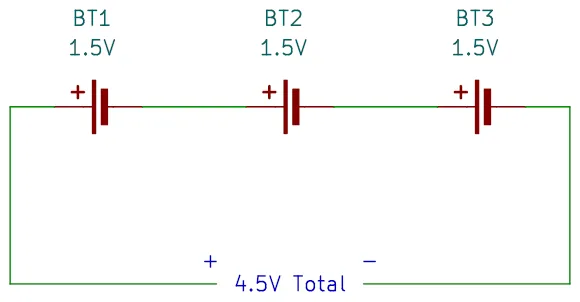
The basic procedure is to connect the positive terminal of one battery to the negative terminal of the next battery. The two remaining terminals become the output terminals of the battery supply, as the following image shows. At the left of the image below is the negative terminal of the battery circuit, and the positive terminal is at the right.

Follow these steps to make a simple series battery connection:
- Obtain two or more batteries with suitable voltage ratings and compatible characteristics.
- Identify the positive (+) and negative (-) terminals of each battery.
- Connect the positive terminal of the first battery to the negative terminal of the second battery.
- If using more than two batteries, continue connecting the positive terminal of each battery to the negative terminal of the next.
- The negative terminal at one end and the positive terminal at the other end are the output connections.
- Check the total voltage with a multimeter before connecting the battery supply to your circuit.
Using Battery Holders
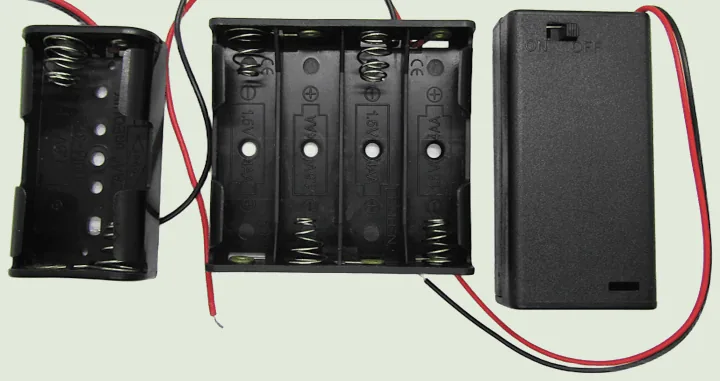
The above steps are theoretical connections, but in practice it is much easier to use a ready made battery holder. Battery holders are available for different sized batteries, for example AA, AAA, C and D size cells. They are also available in arrangements that hold different numbers of batteries, for example a battery holder that connects two 1.5V cells in series, or one that connects three cells in series.
At the left of the below image is a two AA cell battery holder that connects two 1.5V or 1.2V AA sized cells in series to make a 3V or 2.4V battery pack. In the middle of the image is a holder that connects 4 AA cells in series. At the right of the image is a two AA cell holder that has a closing cover and built-in on/off switch. These are just some examples of the many types of battery holders available.
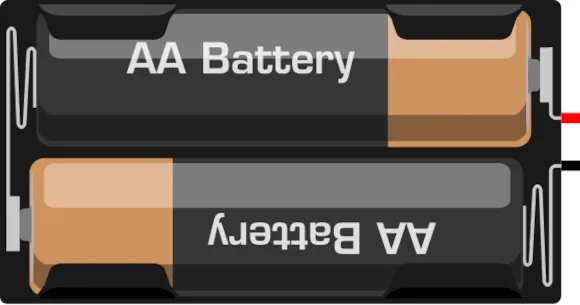
The following image shows an example of a two cell battery holder that is a practical implementation of the previous image that shows two cells placed next to each other and joined. Two 1.5V cells are connected in series by the battery holder itself. At the left of the image below, contacts in the holder connect the negative terminal of the top battery to the positive terminal of the bottom battery. The red marking at the right is the positive terminal for the battery combination, and the black marking on the right is its negative terminal. This combination of two 1.5V cells in series makes up a 3V battery pack. Although these two cells are placed next to each other, rather than end to end, they are still electrically connected in series.
Battery vs Cell: What Is the Difference?
The terms battery and cell are often used interchangeably in everyday language, but they have different technical meanings. Understanding the distinction is useful when discussing batteries in series and other battery configurations.
A cell is a single electrochemical unit that converts chemical energy into electrical energy. It has a positive terminal and a negative terminal and produces a voltage determined by its chemistry and construction.
A battery, in the strict technical sense, is an arrangement of two or more cells connected together to provide electrical energy. These cells can be connected in series, parallel, or a combination of both.
For example:
- A single AA alkaline unit is technically a cell, with a nominal voltage of 1.5V.
- Two AA alkaline cells connected in series form a battery with a nominal voltage of 3V.
- Four AA alkaline cells connected in series form a battery with a nominal voltage of 6V.
Should You Say Cells in Series or Batteries in Series?
Technically, when connecting individual electrochemical units together, the correct term is cells connected in series.
For example, four individual AA cells connected in series form a battery. Similarly, the individual electrochemical units inside a rechargeable lithium-ion battery pack are called cells.
However, the distinction is not always maintained in everyday electronics terminology. The word battery is commonly used to describe individual units such as AA, AAA, and 9V batteries, even though some of these are technically single cells or assemblies of multiple cells.
The terminology also depends on what is being connected:
| Configuration | Technically Correct Terminology |
|---|---|
| Two individual AA alkaline units connected in series | Two cells connected in series |
| Four individual rechargeable lithium-ion cells connected in series | Four cells connected in series |
| Two complete battery packs connected in series | Two batteries connected in series |
| Several cells assembled into one power source | A battery pack |
| A single AA alkaline unit | A cell |
Which Term Should You Use in Electronics?
In technical descriptions and circuit diagrams, use cell when referring to a single electrochemical unit and battery when referring to an assembly of cells.
For example, a circuit powered by four AA alkaline units could technically be described as being powered by a 6V battery made from four cells connected in series.
Nevertheless, because the term batteries in series is widely used in electronics, it is perfectly understandable to use it when discussing the general practice of connecting individual battery units to increase voltage.
Important: A 9V rectangular battery, for example, is not a single cell. It typically contains six small 1.5V cells connected in series in a single rectangular package, producing a nominal output of 9V.
The distinction is therefore useful to understand, but everyday electronics terminology often uses battery more broadly than its strict technical definition.
Batteries in Series: Understanding the Total Voltage
The main reason for connecting batteries in series is to obtain a higher voltage than a single battery can provide. The total voltage depends on the number of batteries and the voltage rating of each individual battery.
Here are some examples using identical 1.5V batteries:
| Number of Batteries | Individual Voltage | Total Voltage |
|---|---|---|
| 1 | 1.5 V | 1.5 V |
| 2 | 1.5 V | 3 V |
| 3 | 1.5 V | 4.5 V |
| 4 | 1.5 V | 6 V |
| 5 | 1.5 V | 7.5 V |
| 6 | 1.5 V | 9 V |
| 8 | 1.5 V | 12 V |
This makes it easy to select the number of batteries required for a particular electronic project. For example, if a circuit requires a 6V supply and you have 1.5V batteries available, you can connect four batteries in series. Get a battery holder that accommodates four 1.5V cells of the desired size, such as AAA or AA.
Similarly, four rechargeable NiMH AA batteries, each with a nominal voltage of 1.2V, produce a nominal supply voltage of:
Remember that rechargeable batteries and ordinary alkaline batteries have different nominal voltages. Always use the correct voltage rating when calculating the output of a battery pack.
Can You Connect Batteries With Different Voltages in Series?
Yes, batteries with different voltage ratings can be connected in series, provided their chemistry, charging requirements, and other electrical characteristics are compatible. For example, a 1.5V battery connected in series with a 3V battery produces a nominal total voltage of 4.5V. However, using batteries with different capacities, ages, or chemistries is generally not recommended.
The batteries must all carry the same series current. A battery with a lower capacity may discharge more quickly than the others. This can cause excessive discharge or even reverse charging of the weaker battery.
For reliable battery packs, use batteries of the same type, voltage, capacity, age, and condition.
What Happens to Battery Capacity in a Series Connection?
One common misunderstanding about batteries in series is that their amp-hour capacities add together in the same way as their voltages. This is not the case.
When identical batteries are connected in series:
- The total voltage increases.
- The amp-hour capacity remains approximately the same as that of one battery.
- The same current flows through every battery.
- The total stored energy increases because the overall voltage increases.
For example, consider two identical 1.5V, 2000mAh batteries. Connected in series, they produce:
- Total voltage: 3V
- Capacity: 2000mAh
- Nominal energy: 6Wh
The energy calculation is:
A single 1.5V, 2000mAh battery stores approximately 3Wh of nominal energy. Two of these batteries connected in series provide approximately twice the energy at twice the voltage.
Actual usable energy will depend on the battery chemistry, discharge current, temperature, and operating conditions.
Batteries in Series vs Batteries in Parallel
There are two common ways of connecting multiple batteries: series and parallel. Although both methods use multiple batteries, they produce different results.
When batteries are connected in series, their voltages add together while their amp-hour capacity remains approximately the same.
When batteries are connected in parallel, their voltage remains the same while their amp-hour capacities add together.
The following table compares the two arrangements:
| Feature | Series Connection | Parallel Connection |
|---|---|---|
| Voltage | Adds together | Remains the same |
| Ah capacity | Remains approximately the same | Adds together |
| Current through each battery | Same | Divides between batteries |
| Main purpose | Increase voltage | Increase current capacity |
| Positive terminals | Connected to the negative terminal of the next battery | Connected together |
| Negative terminals | Connected to the positive terminal of the previous battery | Connected together |
Example: Two 1.5V Batteries
Consider two identical 1.5V batteries, each with a capacity of 2000mAh.
Connected in series:
- Voltage = 3V
- Capacity = 2000mAh
- Energy = 6Wh
Connected in parallel:
- Voltage = 1.5V
- Capacity = 4000mAh
- Energy = 6Wh
Both arrangements provide approximately the same total nominal energy, but at different voltages and capacities.
The correct arrangement depends on the requirements of the electronic circuit or equipment being powered.
What Is a Battery Series Circuit?
A battery series circuit is a circuit in which two or more batteries are connected end-to-end to provide a combined voltage. The batteries form part of the same electrical path, so the same current passes through each battery and through the connected load.
For example, consider a simple circuit containing three 1.5V batteries connected in series and an LED with a suitable current-limiting resistor as shown below. The battery pack supplies a total nominal voltage of 4.5V.
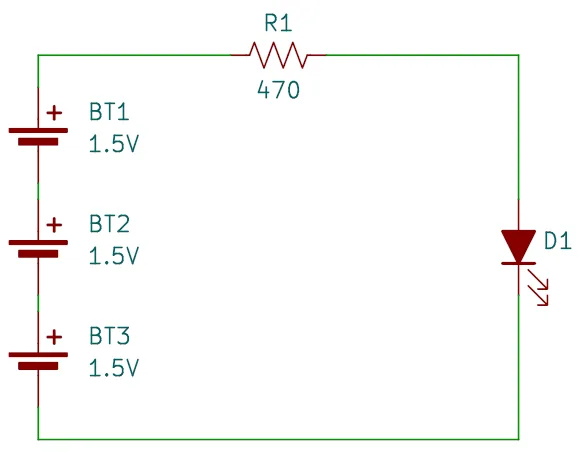
Current flows from the positive output terminal, through the resistor and LED, and returns to the negative output terminal.
The resistor is important because an LED must have its current limited to a safe operating value.
A battery supply with a higher voltage can damage electronic components if the circuit is not designed to handle it.
Practical Uses of Batteries Connected in Series
Batteries connected in series are used in many everyday devices and electronic applications.
Some common examples include:
- Flashlights: Multiple batteries are often connected in series to provide the voltage required by the lamp or LED driver.
- Remote-controlled toys: Battery packs provide the voltage needed by small electric motors and control circuits.
- Portable electronic equipment: Series battery arrangements are used to supply the voltage required by internal electronic circuits.
- Battery-powered tools: Multiple cells are connected in series to provide the higher voltage required by motors and electronic control systems.
- Robotics projects: Battery packs can provide suitable supply voltages for motors, motor drivers, and control electronics.
- Electronic experiments: Connecting batteries in series is a convenient way to experiment with different supply voltages.
The number and type of batteries used depend on the voltage and current requirements of the equipment.
Tips for Batteries in Series
Follow these practical tips when connecting batteries in series to build a reliable battery supply.
1. Check the battery polarity: Always identify the positive and negative terminals before making connections. Reversing a battery can cause problems, particularly when several batteries are connected together.
2. Use matching batteries: Ideally, use batteries of the same chemistry, voltage, capacity, age, and condition. This helps prevent one battery from becoming depleted before the others.
3. Calculate the total voltage: Add the individual battery voltages before connecting the pack to your circuit. Make sure the resulting voltage is suitable for the electronic components.
4. Use a battery holder: A proper battery holder provides secure electrical connections and makes replacing batteries easier.
5. Measure the output voltage: Use a multimeter set to DC voltage to check the completed battery pack. Connect the red probe to the positive output and the black probe to the negative output.
6. Check the current requirements: A battery pack must be capable of supplying the current required by the circuit. Connecting more batteries in series increases voltage, but does not automatically increase the current capacity.
7. Avoid mixing old and new batteries: A new battery connected in series with a partially discharged battery can create an unbalanced battery pack.
8. Observe battery safety: Never deliberately short-circuit batteries. Short circuits can produce excessive current, heat, leakage, or fire.
9. Use suitable charging equipment: Rechargeable batteries connected in series must be charged using equipment designed for the particular battery chemistry and pack configuration. Appropriate cell balancing or individual cell monitoring may also be necessary.
10. Check the voltage under load: The voltage measured without a load may be higher than the voltage available when the circuit is operating. For some applications, checking the battery pack under its normal operating load is useful.
Did You Know?
Here are some interesting facts about series battery connections.
Battery Packs Can Contain Many Individual Cells
A battery pack does not have to contain just two or three batteries. Many battery-powered devices use packs containing numerous individual cells connected in series.
For example, a pack made from ten lithium-ion cells, each with a nominal voltage of 3.6V, has a nominal voltage of 36V.
The actual fully charged voltage will be higher and depends on the specific cell chemistry and charging limits.
A Higher Voltage Does Not Mean a Higher Amp-Hour Capacity
Although connecting batteries in series increases the total voltage, the amp-hour capacity remains limited by the individual cells. This is why manufacturers specify battery packs using both voltage and capacity.
For example, a 12V, 2Ah battery pack and a 6V, 4Ah battery pack both have a nominal energy rating of 24Wh.
Series and Parallel Connections Can Be Combined
Battery packs can use a combination of series and parallel connections. This arrangement is commonly called a series-parallel battery configuration.
For example, two groups of three identical 1.5V batteries can each be connected in series to produce 4.5V. Connecting those two groups in parallel maintains the 4.5V output while increasing the total amp-hour capacity.
This arrangement is useful when both a particular voltage and a higher capacity are required.
Batteries Have Internal Resistance
Every real battery has some internal resistance. When batteries are connected in series, their internal resistances also add together.
This means that increasing the number of batteries in series increases the total internal resistance of the battery pack, assuming otherwise identical cells.
The internal resistance causes a voltage drop when current flows through the battery pack. This is one reason why the measured output voltage can decrease when a circuit draws current.
Frequently Asked Questions
Do Batteries in Series Increase Voltage?
Yes. When batteries are connected in series, their individual voltages add together. For example, two 1.5V batteries produce 3V, while four 1.5V batteries produce 6V.
The total voltage is calculated by adding the voltage of every battery in the series connection.
Do Batteries in Series Increase Amp-Hour Capacity?
No. The amp-hour capacity of identical batteries connected in series remains approximately the same as the capacity of one battery.
For example, two 2000mAh batteries connected in series produce a battery pack with a capacity of approximately 2000mAh, not 4000mAh. However, the total energy increases because the voltage increases.
Can You Connect Two Different Batteries in Series?
It is possible to connect batteries with different voltage ratings in series, but it is generally best to use matching batteries.
Batteries with different capacities, ages, or chemistries can discharge at different rates. This may cause one battery to become depleted before the others.
For reliable operation, use batteries with matching electrical and chemical characteristics.
Can You Connect Batteries in Series and Parallel at the Same Time?
Yes. Series-parallel battery arrangements are commonly used when a battery pack needs both a higher voltage and a higher capacity. For example, two identical groups of four batteries connected in series can then be connected in parallel.
The resulting pack has the voltage of one four-battery series group, while its amp-hour capacity is approximately twice that of one group. However, the cells and connections must be suitable for this configuration.
Does Current Increase When Batteries Are Connected in Series?
The current does not automatically increase when batteries are connected in series.
The same current flows through every battery in the series circuit. The current drawn by the load depends on its electrical characteristics and the voltage supplied by the battery pack.
For a resistive load, Ohm’s law can be used to calculate the current:
Increasing the supply voltage can increase the current through a fixed resistance, but the battery pack must be capable of safely supplying that current.
How Many Batteries Can You Connect in Series?
There is no single maximum number of batteries that applies to every situation.
The practical limit depends on the battery chemistry, voltage ratings, circuit requirements, insulation, wiring, protection arrangements, and safety considerations.
You must also ensure that the combined voltage does not exceed the maximum input voltage of the equipment being powered.
What Happens If You Connect a Battery Backwards?
If one battery is connected with the wrong polarity, its voltage opposes the voltage of the other batteries.
This can reduce the total output voltage and create potentially dangerous operating conditions. Under certain circumstances, a battery can be forced into reverse charging, causing damage or leakage.
Always check the polarity of every battery before completing a series connection.
Can Rechargeable Batteries Be Connected in Series?
Yes. Rechargeable batteries are commonly connected in series to create battery packs with higher voltages. However, the batteries must be compatible, and the charging system must be designed for the specific battery chemistry and number of cells.
Lithium-ion battery packs, in particular, generally require suitable battery management systems (BMS) to monitor cell voltages and provide appropriate protection.
Conclusion
Connecting batteries in series is a straightforward way to increase the voltage available from a battery supply. By connecting the positive terminal of one battery to the negative terminal of the next, their individual voltages add together to produce a higher total voltage.
The most important points to remember about batteries in series are that the total voltage increases, the amp-hour capacity remains approximately the same, and the same current flows through every battery.
Understanding these principles makes it easier to select the correct battery arrangement for electronic projects and everyday equipment. Whether you are building a simple LED circuit, powering a small motor, or experimenting with battery packs, knowing how to connect batteries in series will help you design safer and more reliable electronic circuits.