
What is a short circuit, and why can it cause so much damage to an electrical or electronic circuit? A short circuit occurs when electric current finds an unintended path with much less resistance than the normal path through the circuit. This can cause a large current to flow, potentially overheating wires, damaging components, or creating a fire hazard.
Understanding short circuits is important for anyone learning electronics, building circuits, or working with electrical equipment. Short circuits can occur in simple battery-powered projects, electronic devices, household wiring, and industrial electrical systems. Fortunately, understanding their causes and knowing how to prevent them can help you protect both equipment and people.
What Is a Short Circuit?
A short circuit is an electrical fault that creates an unintended, low-resistance path between two points in a circuit. The current may bypass the intended load, such as a light bulb, motor, or electronic component, and flow through the new path instead.
To understand short circuits, consider a simple circuit consisting of a 12V battery connected to a load by two wires. Under normal conditions, current flows from the battery’s positive terminal, through the load, and back to the negative terminal. The load uses electrical energy to produce light, motion, heat, or another useful effect.
If a wire accidentally connects the positive and negative sides of the circuit directly, it creates a short circuit. Because the wire usually has much less resistance than the load, most of the current flows through this unintended path.
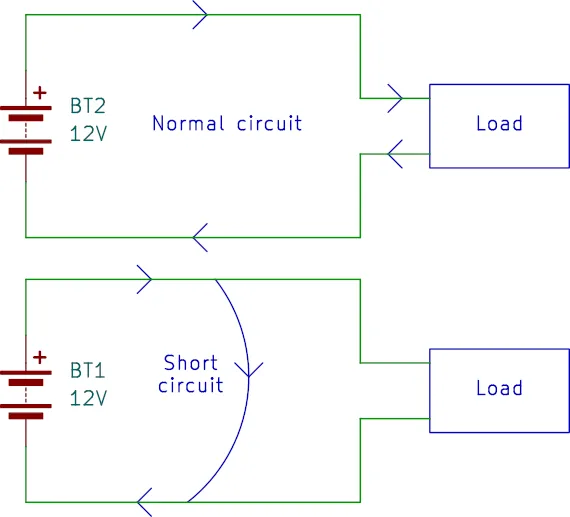
The above image illustrates the difference between normal operation and a short circuit. In the normal circuit, the load controls the current according to its electrical characteristics. In the shorted circuit, the low-resistance wire provides an alternative path that bypasses the load.
What Does a Short Circuit Mean in Practical Terms?
What does a short circuit mean when working with real electrical circuits? It means that current is flowing along a path that was not intended to carry it.
For example, imagine connecting a small light bulb to a battery. The bulb has electrical resistance, which limits the current flowing through it. If a metal wire is then connected directly across the battery terminals, the wire bypasses the bulb, because the wire has a lower resistance than the bulb.
The resulting current can be much greater than the current during normal operation. The battery, connecting wires, and shorting wire may heat up rapidly.
A short circuit does not always mean that resistance is literally zero. Real wires, battery terminals, and connections have some resistance. However, the resistance may be low enough to allow a dangerously large current to flow.
Why Does a Short Circuit Cause High Current?
Ohm’s law explains why a short circuit can produce excessive current:
Where:
- is the current in amperes (A).
- is the voltage in volts (V).
- is the total resistance in ohms (Ω).
For a given voltage, reducing the resistance increases the current. Consider a simplified example using a 12 V supply.
| Circuit Condition | Total Resistance | Current |
|---|---|---|
| Normal load | 12 Ω | 1 A |
| Lower-resistance path | 1.2 Ω | 10 A |
| Short-circuit path | 0.1 Ω | 120 A |
These figures are illustrative and assume an ideal voltage source with the stated total resistance. A real battery or power supply has internal resistance and current limitations, so the actual current will depend on the source, wiring, and connections.
Even so, the example demonstrates why a short circuit can be dangerous. A circuit designed to carry 1A may experience a much larger current if a low-resistance path develops.
What Is an Electrical Short Compared With a Normal Circuit?
An electrical short is another name for an unintended low-resistance connection that causes current to take an abnormal path. The important distinction is between the path that the circuit is designed to use and the path created by the fault.
In a normal circuit, current flows through the intended components. In a shorted circuit, some or most of the current may bypass those components.
| Feature | Normal Circuit | Short Circuit |
|---|---|---|
| Current path | Through intended components | Through an unintended path |
| Resistance | Determined by the load and wiring | Often much lower than intended |
| Current | Within the expected operating range | May rise to a dangerous level |
| Component operation | Usually normal | May stop working or behave unpredictably |
| Heating | Normally manageable | Can become excessive |
| Protection | Usually remains inactive | A fuse or breaker may disconnect the circuit |
Not every low-resistance connection is a fault. For example, a switch that is closed is designed to have very low resistance. A wire connecting two points that are intentionally at the same electrical potential is also not necessarily a short circuit.
A short circuit is a problem when the unintended connection creates an abnormal current path or defeats the intended function of the circuit.
Common Types and Examples of Short Circuits
Short circuits occur in many kinds of electrical systems. The exact consequences depend on the voltage, available current, source characteristics, and the protection devices installed.
Battery Short Circuit
A battery short circuit occurs when a low-resistance path connects the battery’s positive and negative terminals, either directly or through faulty wiring or another conductive object.
For example, placing a metal tool across the terminals of a battery can create a short circuit. The resulting current may heat the tool and battery terminals, damage the battery, or cause burns.
The risks depend on the battery type and its ability to supply current. Rechargeable lithium-ion batteries, automotive batteries, and other high-current sources can be particularly hazardous.
Possible consequences include:
- Rapid heating of wires and metal contacts.
- Burns caused by hot conductors.
- Damage to the battery or connected equipment.
- Leakage, venting, or fire under certain conditions.
- Melting or welding of metal objects across the terminals.
Never deliberately short a battery to test it. Use an appropriate battery tester or a properly designed circuit instead. Keep conductive objects away from exposed battery terminals, and follow the battery manufacturer’s safety instructions.
Outlet Short Circuit
An outlet short circuit can occur when a fault in an electrical receptacle, connected appliance, or associated wiring creates an unintended connection between conductors.
Possible causes include damaged insulation, loose connections, moisture, faulty plugs, and defective appliances.
A short circuit in household wiring may cause a fuse to blow or a circuit breaker to trip. You might also notice sparks, a burning smell, unusual heat, or visible discoloration around the outlet.
However, not every outlet problem is a short circuit. An overloaded circuit, loose connection, or ground fault can produce similar symptoms or activate protective devices for different reasons.
If an outlet is hot, scorched, sparking, or smells burnt, stop using it. Do not remove the cover or attempt repairs while it is energized. If it is safe to do so, switch off the affected circuit at the breaker and contact a qualified electrician.
Short to Ground
A short to ground occurs when a conductor connects unintentionally to ground or a grounded part of the equipment.
For example, damaged insulation might allow an energized wire to touch a metal enclosure. Depending on the electrical system, this can create a fault current through the grounding path.
In a properly designed installation, the protective grounding system and overcurrent protection help reduce the danger. Ground-fault protection may also be required or appropriate for certain circuits.
A short to ground can be dangerous because exposed metal parts may become hazardous if the protective system fails or the fault is not cleared.
Short to Voltage
A short to voltage occurs when a signal or power conductor is unintentionally connected to a higher-voltage source. This type of fault is especially relevant in electronic equipment, automotive wiring, and microcontroller circuits.
For example, a digital input designed for 3.3V logic could be damaged if it is accidentally connected to a 12V supply. The result may be excessive current through the input protection structures or permanent damage to the component.
In troubleshooting, the phrase short to voltage can also describe a signal line that has become connected to an unintended power rail.
Internal Short Circuit in a Transformer or Electronic Component
An electrical short can occur inside a component when insulation fails or conductive materials make contact where they should remain separated.
In a transformer, insulation failure between winding turns can cause a shorted turn. This may lead to abnormal current, heating, reduced efficiency, and eventual failure.
Similar faults can occur inside motors, capacitors, integrated circuits, and other electronic components.
Internal shorts can be difficult to identify because the damage may not be visible from outside the component.
What Causes a Short Circuit?
A short circuit can develop through physical damage, incorrect wiring, contamination, component failure, or a design error. Understanding the likely causes makes it easier to prevent faults in both beginner electronics projects and larger electrical installations.
| Cause | How it creates a short circuit | Example |
|---|---|---|
| Damaged wire insulation | Exposes conductors that can touch other wires or metal parts | Two stripped wires touch inside an enclosure |
| Incorrect wiring | Connects points that should remain electrically separate | A wire is placed across the positive and negative supply rails |
| Loose connections | May cause arcing, overheating, or movement that allows conductors to touch | A loose terminal shifts against a nearby conductor |
| Conductive debris | Creates an unintended electrical path | A metal clipping falls across breadboard power rails |
| Moisture or contamination | May allow current to flow between conductors that should be insulated | Water enters electrical equipment |
| Component failure | Internal damage creates an unintended connection | A failed capacitor develops a short between its terminals |
| Poor circuit layout | Leaves conductors too close together or inadequately separated | Exposed leads touch on a crowded prototype board |
| Mechanical damage | Crushing, abrasion, or vibration damages insulation | A wire rubs against a sharp metal edge |
Damaged Insulation and Exposed Wires
Insulation keeps conductors electrically separated. If insulation becomes cracked, cut, worn, or melted, the exposed conductors may touch each other or a conductive enclosure.
This is a common cause of short circuits in appliances, extension cords, vehicle wiring, and electronic projects.
Inspect wiring for damage before using a circuit. Replace damaged cables rather than relying on temporary patches, especially where mains voltage is involved.
Incorrect Wiring During Circuit Assembly
Beginners can accidentally create a short circuit when building circuits on a solderless breadboard or connecting components with jumper wires.
For example, connecting the positive and negative power rails together with a jumper wire creates a low-resistance path across the supply. A misplaced component lead can also connect two points that should remain separate.
Before switching on a new circuit:
- Compare the wiring with the circuit diagram.
- Check the positive and negative power connections.
- Verify the orientation of polarized components.
- Look for misplaced jumpers and stray wire strands.
- Check for solder bridges between adjacent pads.
These simple checks can prevent many avoidable faults.
Conductive Debris and Moisture
Metal fragments, loose screws, wire clippings, solder splashes, and other conductive debris can bridge two electrical connections.
Moisture and contamination can also cause leakage currents or unintended conductive paths. The severity depends on the type of contamination, the spacing between conductors, and the voltage involved.
Keep electronic work areas clean and dry. Before powering a prototype, remove stray wire clippings and inspect the board for solder bridges or other conductive debris.
What Happens During a Short Circuit?
The effects of a short circuit depend on the power source and the electrical path. A small battery-powered circuit may simply stop working or activate its protection, while a high-current source can deliver enough energy to melt conductors or start a fire.
Excessive Current and Heat
When resistance drops, current can rise sharply. The wires and connections carrying that current generate heat.
The heating effect is described by the equation:
Here, is the power converted into heat in watts, is current in amperes, and is resistance in ohms.
Although a shorting wire has low resistance, the current may be so high that the wire and its connections still heat significantly. A poor connection can become particularly hot because it concentrates electrical losses in a small area.
Damage to Electronic Components
Excessive current can damage circuit board traces, semiconductor devices, connectors, and power supplies.
For example, a short between the power and ground rails of a microcontroller board may cause its regulator to shut down, overheat, or fail. A computer or other electronic device may also stop operating when a short activates its protection circuitry.
Some power supplies include current limiting or automatic shutdown. Others may be damaged if a fault persists.
Voltage Drop and Circuit Malfunction
A short circuit can cause the supply voltage to fall because the source and connecting wires have resistance.
This voltage drop may cause other parts of the circuit to malfunction, reset, or stop operating. In larger electrical systems, a fault can affect other equipment connected to the same supply.
Fire and Injury Hazards
A high-current short circuit can ignite nearby combustible materials or produce hot metal particles and electrical arcing.
In mains-powered systems, fault currents can be extremely high. There may also be a risk of electric shock, especially if insulation or grounding is defective.
Never intentionally create a short circuit on a household outlet, mains supply, or high-current battery to demonstrate the effect. Use a low-voltage educational circuit with suitable current limiting and supervision instead.
How to Detect a Short Circuit
Recognizing the warning signs of a short circuit can help prevent further damage. However, the symptoms alone do not always identify the exact fault.
Common Warning Signs
Look for the following signs:
- A fuse blows immediately after power is applied.
- A circuit breaker trips repeatedly.
- A power supply enters current-limit mode or shuts down.
- Wires, connectors, or components become unusually hot.
- An electronic device stops working after being connected.
- There is a burning smell, visible smoke, or scorching.
- A battery becomes unusually hot during use or charging.
If you notice smoke, burning, or dangerous heat, disconnect power only if it is safe to do so. Do not touch hot or exposed conductors. For mains-powered equipment, switch off the supply using a safe means and seek qualified assistance.
How to Check for a Short Circuit With a Multimeter
A multimeter can help identify a short circuit in a low-voltage electronic project, provided the circuit is isolated from power and the measurement is performed correctly.
Follow these general steps:
- Disconnect the power. Switch off and unplug the power source, and disconnect batteries where appropriate.
- Discharge stored energy safely. Capacitors can retain dangerous charge. Follow the equipment manufacturer’s discharge procedure and never short a capacitor with a tool to discharge it.
- Inspect the circuit. Look for misplaced wires, solder bridges, damaged insulation, or component leads touching.
- Set the multimeter to resistance or continuity test mode. Follow the meter’s instructions and check its probes against each other to understand their normal resistance.
- Measure the unpowered circuit. For a low-voltage project, measure between the positive supply rail and ground.
- Interpret the reading. A sustained resistance close to the resistance of the test leads may indicate a direct short, but it is not conclusive on its own.
A low resistance reading does not always mean a fault. Capacitors may cause the reading to change as they charge from the meter’s test current, and some circuits naturally have low-resistance paths. Semiconductor devices and parallel components can also affect the measurement.
Likewise, a continuity buzzer may sound in a circuit that is operating normally. Consult the schematic and component specifications before deciding that a short exists.
Never measure resistance or continuity on an energized circuit. Also, never place a multimeter set to current mode directly across a battery or voltage source. This can create a short through the meter and damage the instrument or cause injury.
How to Prevent Short Circuits
Preventing a short circuit is usually easier and safer than repairing the damage it can cause. Good wiring practices, careful circuit assembly, suitable component selection, and correctly designed protection all help reduce the risk.
Use Fuses and Circuit Breakers
A fuse or circuit breaker interrupts a circuit when current exceeds an appropriate limit for long enough.
Choose protection based on the circuit’s normal current, wire ratings, power source, and expected fault conditions. A fuse that is rated too high may fail to protect the wiring, while one rated too low may open during normal operation.
For battery-powered projects, place a suitable fuse close to the battery’s positive terminal when appropriate. This helps protect the wiring if a fault occurs downstream.
Remember that a fuse does not prevent a short circuit from occurring. It helps limit the consequences by disconnecting the supply when its operating conditions are met.
Use Proper Insulation and Wiring Techniques
Keep conductors separated and protect them from sharp edges, heat, vibration, and mechanical stress.
Practical measures include:
- Use wires with insulation suitable for the voltage and environment.
- Secure connections so that conductors cannot move into contact with other terminals.
- Use suitable connectors, enclosures, and strain relief.
- Cover exposed conductors where necessary.
- Avoid loose wire strands that can bridge adjacent terminals.
- Replace damaged cables and connectors instead of continuing to use them.
Electrical tape and heat-shrink tubing can be useful in appropriate low-voltage applications, but they are not a substitute for repairing damaged mains wiring or using correctly rated insulation.
Check Circuit Diagrams Before Applying Power
Before powering a newly assembled circuit, compare the physical wiring with the schematic.
Pay special attention to power rails, component orientation, transistor pinouts, integrated circuit supply pins, and connections between ground and the positive supply.
When using a breadboard, remember that the connected holes follow a particular pattern. The long power rails and groups of connected terminal holes may differ between breadboard models. Check the board’s layout rather than assuming all holes are connected in the same way.
Use a Current-Limited Power Supply
A current-limited bench power supply can reduce the energy delivered during initial testing.
Set the voltage to the value required by the circuit and choose a reasonable current limit based on the circuit’s expected operating current and startup behavior.
If a short is present, the supply may limit its output current instead of delivering the full current that the source could otherwise provide.
Current limiting is not a substitute for proper circuit protection, and it does not make every fault harmless. It is nevertheless a useful precaution when testing new low-voltage designs.
Keep Circuits Clean and Dry
Remove conductive debris from circuit boards and work surfaces. Avoid placing exposed electronics where liquids, metal objects, or loose hardware can fall onto them.
For equipment used in damp or dusty environments, select enclosures and connectors designed for those conditions.
Avoid Overloading Electrical Outlets
An overloaded outlet circuit is not necessarily experiencing a short circuit. Overloading happens when too much current is drawn through an otherwise connected circuit, whereas a short circuit creates an unintended low-resistance path.
Both conditions can cause overheating, and both require appropriate protection.
Avoid connecting too many high-power appliances to the same circuit. If breakers trip repeatedly, have the cause investigated rather than replacing the breaker with one of a higher rating.
Tips for Short Circuits
When learning what a short circuit is, it helps to combine the theory with safe testing habits. The following tips are useful for electronics beginners, students, and hobbyists.
- Check power connections first. Before switching on a circuit, verify that positive and negative supply connections are not accidentally joined.
- Use a current-limited supply for prototypes. Begin testing with an appropriate current limit and monitor the supply for unexpected current draw.
- Inspect breadboards carefully. Check for misplaced jumper wires, bent component leads, and metal clippings that could bridge adjacent connections.
- Use a multimeter correctly. Test resistance and continuity only on circuits that are de-energized and safe to measure.
- Fit suitable circuit protection. Select fuses and other protective devices according to the circuit’s requirements rather than guessing their ratings.
- Investigate repeated fuse or breaker operation. A protective device that repeatedly opens is warning you of a problem. Do not bypass it.
- Keep batteries protected. Prevent metal objects from bridging battery terminals, and use suitable wiring and overcurrent protection in battery-powered projects.
- Understand the circuit before troubleshooting. A schematic helps you identify which connections should be electrically common and which should remain separate.
A useful habit is to check a circuit before power is applied, rather than waiting for a fault to reveal itself. A few moments spent checking wiring can save components and reduce safety risks.
Did You Know?
Short circuits are usually discussed as faults, but understanding their electrical principles also helps explain several important concepts in electronics.
A Short Circuit Is Not Always a Zero-Ohm Connection
In an ideal circuit diagram, a wire may be treated as having zero resistance. Real wires, contacts, and power sources always have some resistance.
A practical short circuit can still be extremely dangerous even when its resistance is not zero. The important issue is whether the unintended path allows more current than the circuit can safely carry.
A Short Circuit Can Bypass a Load
In the example of the 12V battery and load, the shorting wire provides an alternative route for current. This is why the load may stop functioning as intended.
However, the exact current distribution depends on the resistance of each path and the characteristics of the source. It is not always correct to assume that all current flows through the short or that the load receives exactly zero current.
A Fuse Does Not Prevent the Initial Fault
A fuse is designed to interrupt excessive current, not to stop wires or components from making unintended contact.
Some current can flow before the fuse opens. The amount of energy released during that time depends on the available fault current and how quickly the protection operates. This is one reason why selecting the correct fuse and placing it appropriately matters.
A Short Circuit Can Be Intentional in Certain Designs
Engineers sometimes design circuits that deliberately connect a signal or node to a defined reference through a switch or other controlled path. Such a connection is not necessarily a fault.
The term short circuit describes an electrical condition, and whether that condition is a problem depends on the circuit’s design. An unintended connection between a power rail and ground is generally a fault, while a designed low-resistance connection can be part of normal operation.
Frequently Asked Questions
What is a short circuit in simple terms?
A short circuit is an unintended electrical connection that allows current to flow along a path with much less resistance than intended. This can cause excessive current, overheating, and damage to wires or components.
What does a short circuit mean for an electronic device?
It means that current may be flowing through an unintended path inside the device or its wiring. The device might stop working, reset, overheat, or activate its protection circuitry. The outcome depends on the source, the location of the fault, and the protection available.
What is an electrical short, and what causes it?
An electrical short is an unintended low-resistance connection between points that should normally remain electrically separate. Common causes include damaged insulation, incorrect wiring, conductive debris, moisture, and component failure.
Can a battery short circuit cause a fire?
Yes. A battery short circuit can cause very high current and rapid heating. Depending on the battery type and the circumstances, this may damage the battery, cause burns, or start a fire. Never deliberately connect a battery’s positive and negative terminals together.
How do I know if an outlet has a short circuit?
Warning signs may include repeated breaker trips, sparks, a burning smell, scorching, or unusual heat. These symptoms can also have other causes. Stop using a suspect outlet and contact a qualified electrician rather than attempting live electrical repairs.
Can a multimeter detect a short circuit?
Yes, a multimeter can help detect a short in an unpowered circuit by measuring resistance or continuity between relevant points. However, low resistance is not always evidence of a fault. The circuit diagram and normal component behavior must also be considered.
What is the difference between a short circuit and an overload?
A short circuit creates an unintended, low-resistance path that may cause a large current to flow. An overload occurs when a circuit draws more current than it is designed to carry, even though the current may still be flowing through the intended load. Both can cause overheating and require appropriate protection.
Will a fuse always stop a short circuit?
A correctly selected fuse can interrupt excessive current, but it does not necessarily prevent all damage. Some heat or arcing can occur before the fuse opens, and a fuse that is incorrectly rated or installed may not provide adequate protection.
Can a short circuit damage a power supply?
Yes. A short circuit can force a power supply to deliver excessive current. A supply with suitable short-circuit protection may limit current or shut down, while an inadequately protected supply may overheat or fail.
Conclusion
Understanding short circuits is an important part of learning electronics and working safely with electrical equipment. A short circuit occurs when current finds an unintended low-resistance path, potentially bypassing the load and causing excessive current, overheating, and component damage.
Common causes include damaged insulation, incorrect wiring, conductive debris, moisture, and component failure. Battery short circuits and outlet short circuits can be particularly hazardous because of the amount of energy available from their power sources.
You can reduce the risk by checking circuit connections before applying power, using suitable fuses and circuit breakers, keeping wiring properly insulated, and testing low-voltage projects with a current-limited power supply. If you suspect a fault in mains-powered equipment, avoid live troubleshooting and seek qualified help.
Once you understand short circuits, how they develop, and how to recognize their warning signs, you will be better prepared to build reliable electronic circuits, troubleshoot problems, and prevent avoidable damage.